

“50 Top Women in STEM”
by James A. Barham, The Best Schools “Freese’s main area of research has been on the dark matter/dark energy problem. In particular, she has made several proposals for ways to detect dark matter experimentally, which have led directly to the IceCube Neutrino Observatory at the Amundsen–Scott South Pole Station in Antarctica, and a worldwide consortium […]

“15 top science & tech leaders offer surprising predictions for 2018” by David Freeman, Denise Chow and Prachi Bhardwaj
NBC News MACH “Last October, an amazing neutron star merger event was discovered via gravitational waves from the Laser Interferometer Gravitational-Wave Observatory (LIGO), and 1.7 seconds later in 70 different detectors in all different wavelengths of light. That means gravity travels at a speed very close to that of light. Combining all this information has […]
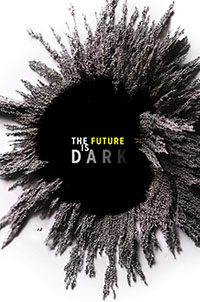
“The Future is Dark” by Elizabeth Wason
University of Michigan LSA “It’s 85 percent of all matter,” says theoretical physicist Katherine Freese about dark matter in the universe. “We’ve got to find out what the hell it is, obviously.”
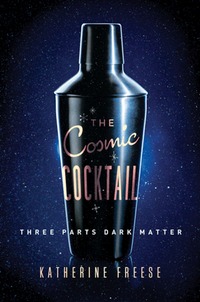
LSA’s “Summer School” Reading List Includes The Cosmic Cocktail
University of Michigan LSA Physicists take dark matter seriously, and The Cosmic Cocktail author and LSA physicist Katherine Freese is no exception. In her recent book, Freese combines hardcore research with funny anecdotes to show what some scientists do when their academic conference shuts down for the day. Freese herself hangs out with the queen […]
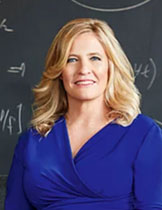
“A Mind Bending Physics Theory: Did Dark Stars Form The Universe?” by Mr. Peppermint
Onedio Thirty years ago, her theories about an unseen glue that helped shape the Universe led to the building of underground particle accelerators around Earth, such as the machines at Cern in Europe. And the particle they are looking for? They are called Wimps, and according to Freese, stars made of this illusive stuff may […]
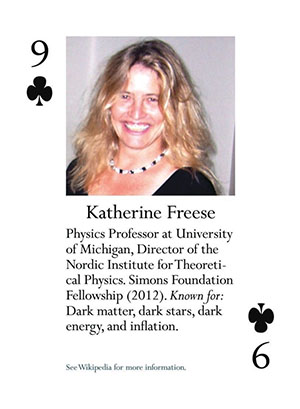
“Notable Women in the Physical Sciences”
The Educational Card Project Freese featured as a card in the Educational Card Project.
“Virtual Special Issue on Women in Physics 2017”
by Kate Keahey, Elsevier The article featrures “Cardassian expansion: a model in which the universe is flat, matter dominated, and accelerating” – Katherine Freese, Matthew Lewis