
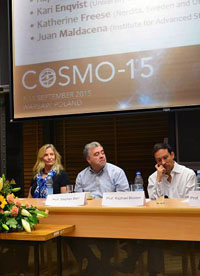
“COSMO-15: Is physics soon going to exceed its boundaries – just to immediately set some new ones?”
by Leszek Roszkowsk “I think that the sciences always were and always will be experiment-driven. History has shown that new surprising results that strongly stimulate development often appear suddenly even in times, in which progress in research is seemingly slow. Boundaries of the sciences are set by our technological capabilities. We will be witnessing progress […]

Freese quoted in Expressen article
by Arne Lapidus “‘Hawking’s research is very theoretical. He has changed the way people think about the universe. His main contributions are theories about black hole physics, the universe and singularities,’ says Katherine Freese, a professor of physics in Stockholm and Michigan and Director of the Research Centre Nordita in Stockholm, which organizes the weekly […]
Freese quoted in Svenska Dagbladet article
by Anton Assarsson “Katherine Feese highlights Stephen Hawking’s research on black holes and his contributions to the understanding of the universe’s beginnings as crucial. ‘We physicists are still working with the questions formulated by Albert Einstein a long time ago. To solve these issues, we have relied to some great thinkers – and Stephen Hawking […]

“The 15 most amazing women in science today” by Emmie Martin
Business Insider Freese was named one of Business Insider’s 15 most amazing women in science today. “Author of “The Cosmic Cocktail,” Katherine Freese was one of the first women undergraduate students to graduate with a physics major from Princeton University.”
“50 groundbreaking scientists who are changing the way we see the world” by Jessica Orwig and Emmie Martin
Business Insider UK Freese was included in Business Insider UK’s list of 50 scientists from across the globe who are changing the world for the better.
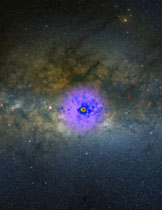
“Mysterious galactic signal points LHC to dark matter” by Davide Castelvecchi
Nature “Katherine Freese, director of Nordita, the Nordic Institute for Theoretical Physics in Stockholm, says that she and her collaborators have calculated that the excess could be caused by a type of dark matter that features in a less-popular theory of supersymmetry.”